
The Disappointment Curve
😟 Not every stage of the process is going to feel exciting.

Folks who survived the Mad Men era all have at least one story about selling an idea, going off to produce it, coming back and showing the final product only to have the client say they hate it. Start over. You don't see that these days because we have taught ourselves/created a system to get approval at every single stage in the process. Problem is, not every stage of the process is going to be exciting or even look much like the finished product. But let's back up, there are two things that also contribute to The Disappointment Curve.
It's become harder for people to use their imagination.
It's become easier and easier to create comps that look very much like a finished product. This is not good actually. You want your production partner (director, animator, photographer, etc.) to come with their own ideas and expertise that make your idea better. But often, if you can't show it exactly – and how can you before you make the thing – they won't buy it. Or it makes them nervous because it's hard for them to make a leap of imagination. This is why it's often far easier to sell something that already exists rather than sell something that could exist, even if it would be 10x more interesting/branded/buzzy/strategic/awesome. Yes, there's risk aversion too. But there will be many stages of production where what you're looking at will not look anything like the end result.
Accepting differences.
No two designers will ever make the exact same choices. Because the choices are infinite and there are different ways to say the same thing. If I'm supervising another designer on a project, I need to accept that it's never going to be exactly the way I might imagine it. But does it answer the brief just as well? Is it still on the path we agreed upon? Is it better than what I had in my head? Often so. And there are times to make adjustments. But I need to let go of every tiny choice. That's a learned skill. The tendency is every layer of approval might have an opinion on something like the thickness of a rule line. It's a false sense of control. Projects evolve as they move through. Accept differences.
The Disappointment Curve
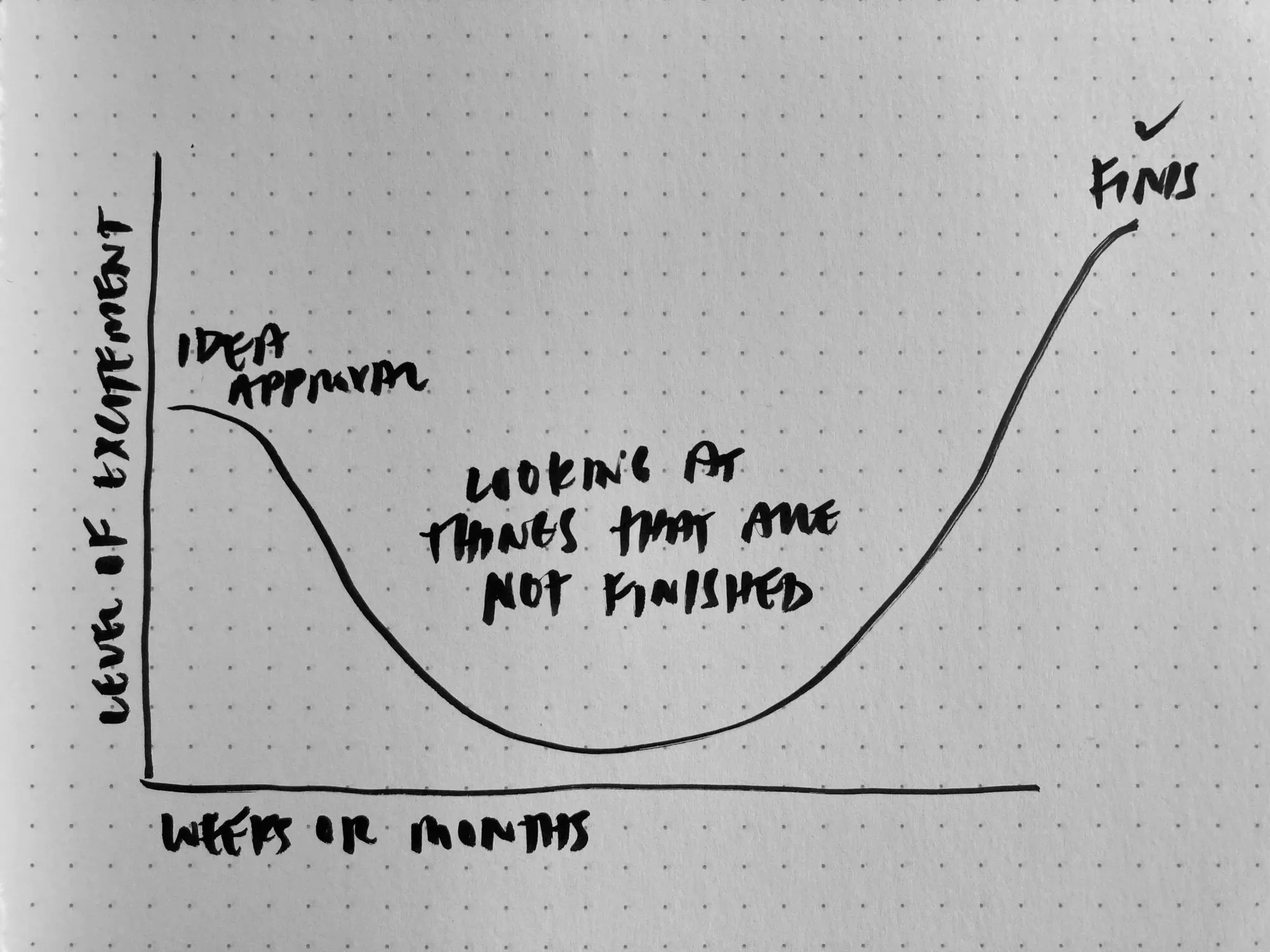
Excitement is high when a new concept is approved. It dips as you go through parts of the production process that are not as exciting or that don't seem to look like anything or that seem confusing – things like wireframes, CAD models, rough cuts, sketches. But there's no way to avoid them in this system of approvals at every stage. There is a point where excitement can bottom out, internally or externally. It can feel like you're moving away from the final object before you feel like you're moving toward it. Once you get past a certain point, excitement starts to build again culminating in the finished thing.
Things to keep in mind:
- Manage expectations. Take anyone who will need to approve things through the steps of the process and let them know what they're looking at for each step. For example: This wireframe is only for structure and where content goes. This printer dummy is not for judging color. This CAD file is only for angle.
- Accept differences. Big differences in agreed-upon style or strategy or budget are an issue to be discussed, but small differences can be OK. They might be better than what you had in mind. Part of why you're hiring a specialist is to have them contribute and evolve the project along the way.
- Remember why you hired the director/animator/CGI artist. If someone is at the bottom of the curve, remind them of what was in the portfolio or treatment that got everybody excited in the first place.
- Not everything is excitement. Welcome to the creative process. I wrote about one creative superpower which is being OK with vague discomfort. Or with things that are unfinished or unresolved. If you can let go of needing to feel like every step needs a "wow," you might find the process pretty cool.